
Deep Plane Facelift in San Diego
BSA Plastic Surgery | La Jolla, San Diego, CA
Overview
A patient considering a facelift often finds the concern difficult to put into words. She still feels like herself, but her jawline looks softer, her cheeks sit differently, or the face she sees in photographs looks more tired than she feels.
The change she wants may be meaningful, yet she is cautious about looking unfamiliar. That is an important place to begin.
A deep plane facelift in San Diego offers an approach to facial rejuvenation that addresses the deeper supporting tissues of the face. Rather than focusing on skin tightening alone, this technique allows selected facial tissues to be repositioned to improve the appearance of the cheeks, lower face, and jawline.
At BSA Plastic Surgery in La Jolla, Dr. Banafsheh Sharif-Askary approaches every facelift consultation with an understanding that each patient’s anatomy, priorities, and expectations are different. The goal is not simply to make you look younger. It is to create a refreshed appearance while preserving the features that make you recognizable.
About Dr. Sharif-Askary
A facelift is only as good as the surgeon performing it, so understanding your surgeon’s training and experience matters.
Dr. Banafsheh Sharif-Askary is a plastic surgeon and Assistant Professor in the Division of Plastic Surgery at UC San Diego. She is also the founder of BSA Plastic Surgery in La Jolla, where she focuses on personalized aesthetic care and facial rejuvenation.
Her dedicated training in facial aesthetic surgery included advanced education in Manhattan and Korea, shaping her approach to facial anatomy, surgical precision, and natural-looking results.
Her philosophy centers on understanding what each patient wants to improve while respecting the features they want to preserve.
What Is a Deep Plane Facelift?
A deep plane facelift is a surgical facial rejuvenation technique that works beneath the superficial musculoaponeurotic system (SMAS), a supporting layer of tissue beneath the skin.
As the face ages, deeper facial tissues can descend, contributing to changes in cheek position, jowls, and jawline definition.
During a deep plane facelift, selected tissue attachments are released, allowing deeper facial tissues to be repositioned together rather than relying on skin tightening alone.
For appropriately selected patients, this approach can address signs of aging through the cheeks, lower face, and jawline.
However, the technique itself is only one part of the decision. Your surgeon’s training, experience, surgical judgment, and understanding of your anatomy are equally important.
The best facelift is the one that can be performed safely and effectively while matching your individual facial structure and goals.
What Makes a Natural-Looking Facelift?
When a patient says, “I want to look natural,” I want to understand exactly what that means to her.
For one person, it means looking more rested in photographs. For another, it means improving jowls that have become increasingly distracting. Someone else may want a more substantial change while preserving the features she has always liked.
I do not think a natural result has to be an imperceptible one. The purpose of surgery is to make a change. My aim is to plan that change with attention to the whole face, including the relationships between the cheeks, jawline, and neck.
The direction of tissue repositioning, often called the vector of lift, is particularly important. Careful planning helps avoid distortion around the mouth and cheeks.
The goal is for you to look like yourself, on a good day.
During your consultation, we will discuss what you find appealing in other results and what you would be uncomfortable seeing in your own.
Who Is a Good Candidate for a Deep Plane Facelift?
Candidacy involves more than age. Your overall health, tissue changes, expectations, and ability to plan for recovery all matter.
A deep plane facelift consultation may be appropriate if you are concerned about:
- Jowls or reduced definition along the jawline.
- Descent of the cheeks and lower facial tissues.
- Facial laxity that has become more noticeable over time.
- Changes in the face and neck that you would like evaluated together.
Suitable candidates are generally healthy, do not smoke, and have realistic expectations about surgical outcomes.
Medical conditions, nicotine use, medications, and previous procedures all need careful review before surgery.
An examination is necessary to determine whether a deep plane facelift, another surgical approach, or postponing surgery is the right option for you.
Deep Plane Facelift vs. Traditional Facelift
Both deep plane and traditional facelift techniques aim to address visible signs of facial aging, but they differ in how the underlying tissues are approached.
A traditional facelift may involve repositioning the SMAS layer separately from the skin, depending on the specific technique.
A deep plane facelift works beneath the SMAS and releases selected tissue attachments, allowing deeper facial tissues to be repositioned together.
The appropriate approach depends on your anatomy, the extent of facial aging, your goals, and your surgeon’s experience.
There is no single facelift technique that is best for every patient. A personalized surgical recommendation is more important than choosing a procedure based on its name alone.
Does a Deep Plane Facelift Include a Neck Lift?
The face and neck are closely connected, and many patients are concerned about both areas.
Some patients primarily notice changes around their cheeks and jawline, while others are equally concerned about fullness beneath the chin or reduced definition in the neck.
When neck treatment is appropriate, the surgical plan may include:
- Tightening the underlying neck muscle (platysma).
- Addressing excess fat beneath the chin and jawline.
- Evaluating descended submandibular glands that may contribute to neck fullness.
The exact procedures depend on your anatomy and individual needs.
The term “deep plane facelift” alone does not tell you which neck procedures are included. During your consultation, we will discuss exactly what your proposed operation involves.
What a Facelift Does Not Address
A facelift repositions underlying facial structures, but it does not address every aspect of facial aging.
Skin quality, pigmentation, and fine lines
Changes in skin texture, hyperpigmentation, and fine lines, including those around the mouth, may require additional treatments. Chemical peels and microneedling can be considered as complementary treatments.
Changes around the eyes
The tired appearance around the eyes can involve the upper eyelids, lower eyelids, and brows. Depending on your anatomy, eyelid surgery or a brow lift may be considered.
Facial volume loss
Changes in facial volume can contribute to a less full or youthful appearance. Fat grafting may help restore volume in areas such as the cheeks when appropriate.
The consultation helps identify which concerns a facelift can address and which may benefit from other treatments.
Combining a Deep Plane Facelift with Other Procedures
Some patients choose to combine a facelift with additional procedures to address multiple aspects of facial aging.
Depending on your anatomy and goals, these may include:
- Brow lift: Addresses brow position and certain signs of aging in the upper face.
- Eyelid surgery: Addresses changes involving the upper and lower eyelids.
- Facial fat grafting: Restores volume in areas that have experienced age-related volume loss.
- Skin resurfacing: Chemical peels and microneedling may improve skin texture, pigmentation, and fine lines.
Not every patient needs additional procedures. Some treatments may be performed together, while others may be better approached in stages.
Each recommendation should have a clear purpose and be based on your individual needs.
Planning Your Deep Plane Facelift
Facelift planning requires attention to details that are easy to overlook when researching surgery online.
During your evaluation, we consider:
- Facial proportions and natural asymmetry.
- Skin quality and elasticity.
- Hairline and ear anatomy.
- Previous facial procedures or treatments.
- Incision placement and the associated tradeoffs.
- Your desired outcome and expectations.
Incisions are generally positioned around the ears and may extend into the hairline, depending on the operation. Neck treatment may require an additional incision beneath the chin.
Scars are unavoidable, although careful incision placement and healing can help make them less noticeable over time.
Your anesthesia plan, surgical setting, and postoperative care will also be reviewed before surgery.
Deep Plane Facelift Recovery: What to Expect
Recovery deserves the same attention as the operation itself. Before choosing a surgery date, consider your work, family responsibilities, travel, and upcoming events.
Following a deep plane facelift, swelling, bruising, tightness, and temporary changes in sensation can occur.
Your postoperative instructions will explain:
- Incision care and any dressings or drains.
- Prescribed medications.
- Activity restrictions.
- Follow-up appointments.
- When you can gradually return to normal activities.
Returning to work and feeling ready for an important social event are different milestones. Allow flexibility in your plans because healing does not follow an exact calendar.
Exercise, lifting, and other strenuous activities should be postponed until you receive clearance from your surgeon.
How Long Do Deep Plane Facelift Results Last?
A facelift does not stop the natural aging process. Your face will continue to change over time, influenced by factors such as genetics, sun exposure, and lifestyle.
However, a well-planned facelift can provide long-lasting improvements in facial contours and definition.
Rather than promising a specific number of years, my goal is to develop a surgical plan that respects your anatomy and supports the longevity of your results.
Maintaining your results also involves:
- Following a consistent skincare regimen.
- Protecting your skin from sun exposure.
- Considering appropriate maintenance treatments.
- Maintaining healthy lifestyle habits.
The longevity of your results varies from patient to patient.
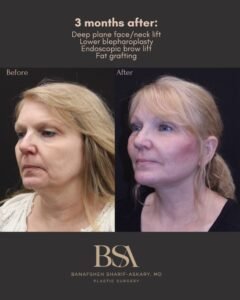
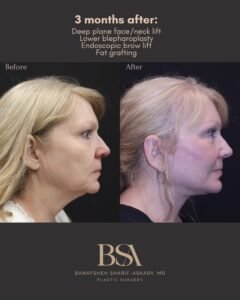
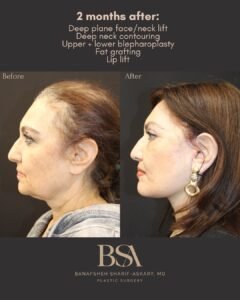
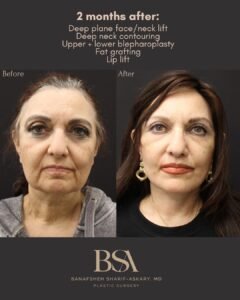
Deep Plane Facelift Before and After Photos
Before-and-after photographs can help you understand the types of changes that may be possible with facial rejuvenation surgery.
When reviewing facelift photographs, consider the patient’s starting anatomy, the procedures performed, and how long after surgery the photographs were taken.
Look at the whole face, including the cheeks, jawline, neck, and overall balance, rather than focusing on a single feature.
During your consultation, we can review appropriate examples to help clarify your preferences and expectations.
Keep in mind that another patient’s results cannot predict your individual outcome.
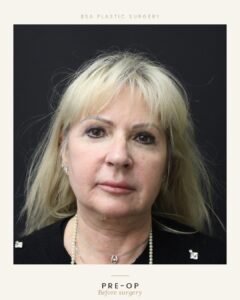
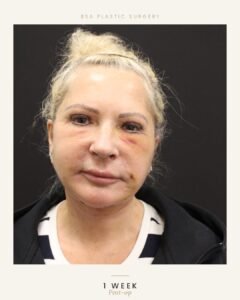
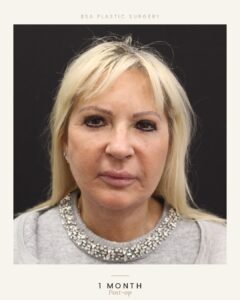
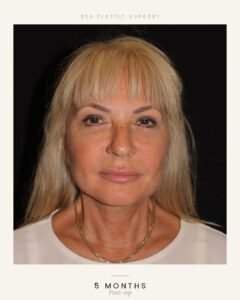
Patient Experiences
Patient experiences can offer insight into the care and attention involved throughout the surgical journey.
“Dr. Sharif-Askary is a phenomenal surgeon! Her keen eye for detail and perfectionism gave me a beautifully balanced, refreshed look after my deep plane face and neck lift with fat grafting. She is kind, gentle, and truly cares about her patients. My results exceeded my expectations, and the entire experience was wonderful. If I could give her a million stars, I would!”
— LP, 60
“Dr. Sharif nailed it! She is amazing and I’m at the 6 week mark and feel fabulous and look fabulous without being overdone.”
— RP, 70
My Approach to Facial Rejuvenation
My aesthetic philosophy centers on proportion, judgment, and respect for individual anatomy.
The face carries a great deal of personal identity. Small details matter: the way the cheek meets the lower face, the contour of the jaw, and how those features relate to the neck.
I want the consultation to be a thoughtful conversation about those relationships. You should feel comfortable explaining your concerns, showing examples, and describing the changes you do not want.
My responsibility is to give you a clear recommendation and explain the reasoning behind it, including when your goals may call for a different approach.
Frequently Asked Questions About Deep Plane Facelift Surgery
1. What is the difference between a deep plane facelift and a traditional facelift?
2. Will I look pulled or overdone after a deep plane facelift?
3. Am I a good candidate for a deep plane facelift?
4. Does a deep plane facelift include a neck lift?
5. How long does recovery take after a deep plane facelift?
6. Can a deep plane facelift be combined with other procedures?
7. How long do deep plane facelift results last?
8. How much does a deep plane facelift cost in San Diego?
9. Where can I get a deep plane facelift in San Diego?
Schedule Your Deep Plane Facelift Consultation in San Diego
If you are considering a deep plane facelift, the best next step is a conversation about what you want to change, what you want to preserve, and what is realistic for your face.
Dr. Banafsheh Sharif-Askary welcomes patients interested in facial rejuvenation at BSA Plastic Surgery in La Jolla, San Diego.
Contact our office to schedule a personalized consultation and learn more about your options.
BSA Plastic Surgery
4150 Regents Park Row, Suite 321
La Jolla, CA 92037
Phone: (858) 988-3771