Rhinoplasty In San Diego
My training has informed how I approach this: First, the academic side of my practice: I earned my bachelor’s and medical degree at Duke University, received Alpha Omega Alpha (AOA) honors, and completed my residency at Georgetown. I am an Assistant Professor at UC San Diego, and I completed my aesthetic fellowship at Manhattan Eye, Ear and Throat Hospital (MEETH). Importantly, I also made a point of gaining hands-on experience in Korea. That experience gave me a particular appreciation for facial nuance and the value of preservation.
All of that shapes my thinking. When I am in consultation, I don’t want to put a patient through a procedure that appears overdone. And I don’t apply the same template to everyone. A good result should be in harmony with your proportions and features. For many, that is a natural enhancement.
When people in San Diego look for a rhinoplasty surgeon, they want to know I understand their anatomy and can achieve a natural-looking result. I think judgment is as vital as technique in this regard.
What Rhinoplasty Can Address
For a successful rhinoplasty result, our assessment must move beyond the generic and focus specifically on you: your particular anatomy, your concerns, and what you are looking to accomplish. A consultation is my opportunity to get a sense of how you want the outcome to look and feel, what you would like to see changed and what you would rather leave as is.
We will review your nasal structure and facial proportions in some detail, as well as other factors like breathing issues. With that information, we can decide if an ethnic, primary, revision, or preservation rhinoplasty is the best approach. I will also outline the pros and cons of open versus closed techniques and cover the risks, limitations, and recovery process so you know what to expect.
An individualized exam is necessary for these procedures because one size does not fit all. If you are thinking about rhinoplasty San Diego and desire something natural and harmonious with your features, I would be happy to see you for a consultation at BSA Plastic Surgery in La Jolla.
Types of Rhinoplasty I Perform
Primary Rhinoplasty
This is for patients who have not had nasal surgery before and want to improve function or appearance. It’s often a personal decision: You may feel a dorsal bump distracts from your other features, or that your tip is poorly defined. Some wish to correct projection or wide nostrils. For others, it’s about correcting a deviated septum or narrowed airway that makes breathing difficult; we can address cosmetic and functional concerns in one plan if the situation calls for it.
I will not decide you need an operation without first looking at your anatomy and hearing what you want to keep as well as what you want to change. Whether I use an open or closed approach depends on the goals we set and your individual needs. My objective is never to give you a nose like someone else’s, but to produce something refined that feels like you.
Revision Rhinoplasty
For those who have already had surgery and are left with an aesthetic or functional issue, or issues that have developed since surgery, revision may be necessary. These cases demand a more careful eye because the anatomy is no longer as it was. Contour irregularities, or a disproportionate result, may occur.
In my work with revision patients in San Diego, I operate on the principle of understanding what is there before making any changes. It is not a case of simply repeating the same procedure. I have to know what was done, what has changed, and what is realistically fixable. The complexity varies significantly from one person to the next that I cannot assume one technique will work.
If the issue is breathing, I look at the underlying structure; if it is aesthetics, I examine the symmetry and how the nose relates to the rest of the face. Often the two are intertwined. The consultation is key to seeing what is possible, as not every approach is right for every patient.
For patients considering revision rhinoplasty San Diego, the consultation is key to understanding what is possible and which approach may be appropriate.
Preservation Rhinoplasty
The philosophy is to refine appearance and function while preserving the nose’s native architecture where we can. A 2023 systematic review puts it well: these techniques are meant to limit disruption to the cartilaginous and soft-tissue structures, though the authors note the evidence has its limitations.
But for me, the technique’s name isn’t the question. It comes back to the fundamentals of rhinoplasty: knowing what to preserve. The question is whether the approach is right for the individual patient. In my conversations about preservation rhinoplasty, I make it clear that preservation isn’t about doing less; the operation must address the patient’s concerns. What sets it apart is the surgical philosophy and an eye for which structures can be left in place.
Much remains to be learned from recent research on how preservation techniques compare with structural ones. A 2025 systematic review and meta-analysis of randomized controlled studies on dorsal hump reduction is a good example, showing the kind of evidence that is being put forward.
As for whether one is a candidate for this type of rhinoplasty, there is no universal answer. It comes down to anatomy, what you want to achieve, and the specific correction needed.
Ethnic Rhinoplasty
This is no different from any other rhinoplasty in terms of attention to proportion and anatomy, but it also considers cultural or aesthetic preferences and the specific features a patient wants respected. I do not set out to erase what makes a face distinctive. My aim is to refine what you would like while keeping everything in harmony with your other features.
Goals can vary widely among patients in San Diego looking into ethnic rhinoplasty San Diego. One may have an issue with bridge width; another wants to talk about tip projection or definition.
There is no one way to define a good result. I will listen first in these consultations; what seems too prominent to one person might be important to another’s identity. I need to understand that before I put together a plan. The end result should be refined but not forced into some preconceived notion of what a nose ought to look like.
Dr. Sharif’s Approach: Academic Precision and Aesthetic Restraint
I bring a certain academic rigor and restraint to my work. Because the nose is central to the face, any change to its shape affects the face’s overall balance. I am as concerned with function as form and aim to address airway issues like a deviated septum. We can combine cosmetic and functional procedures where the anatomy and goals allow.
I do not have a set preference for open or closed techniques. I let the required changes determine the approach. With an open rhinoplasty, for instance, I have a protocol for the incision to stabilize the tip and manage scarring, which is part of the care I provide.
My academic and aesthetic training, along with my hands-on experience in Korea, continues to shape how I approach rhinoplasty. It has reinforced the importance of understanding facial nuance and preserving structure rather than changing it for its own sake.
An aesthetic fellowship at Manhattan Eye, Ear and Throat Hospital (MEETH) gave me focused training, and time in Korea gave me a more nuanced view of the face, and why one should preserve structure rather than change it for its own sake.
For those in La Jolla researching rhinoplasty La Jolla, I prefer our consultation to be a thoughtful discussion, not something decided based on a photograph. A natural result is not always the least invasive one, nor do I adhere to a single shape. Some faces need only a modest touch to be in proportion, others a more significant correction. I am not interested in making every nose smaller or straighter. I want to make the changes that are right for the face in front of me.
Recovery Timeline
The healing process and the nature of the operation will determine the timeline. I go over postoperative care and any restrictions with each patient individually. There is no set timetable for swelling to subside; the nose will keep changing during the healing process.
When patients in San Diego want to fit a rhinoplasty around work or travel, I advise setting aside any generic recovery calendar and discussing timing at your consultation. We need to factor in what kind of correction is needed and how you heal as an individual.
Do not expect the final look right away. The early days of recovery are just the beginning, and as the swelling goes down, the nose will refine itself. I would rather my patients view it as a healing process than expect an immediate result. And while you may feel fine, I do not suggest you rush back to your usual activities. I will tailor your postoperative instructions to your procedure.
For a more in-depth look at preparation, activity levels, and more, I refer you to the Rhinoplasty Complete Guide. You will find the full story there, but your own instructions will be specific to you.
Ultimately, rhinoplasty results are structural and meant to last. That said, the nose will age along with the rest of the face.
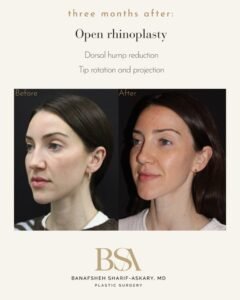
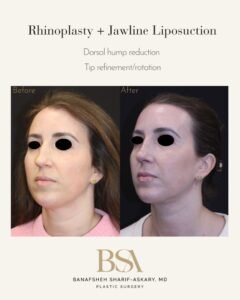
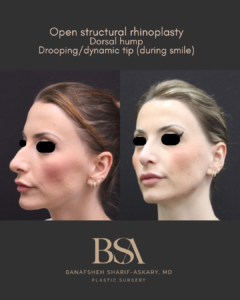
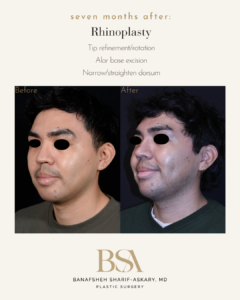
Before and After Gallery
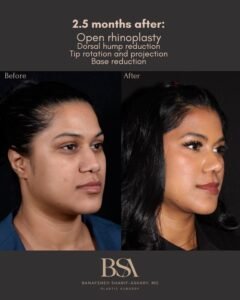
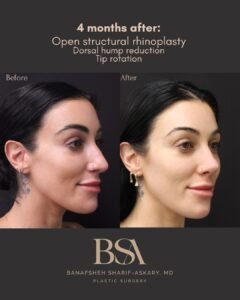
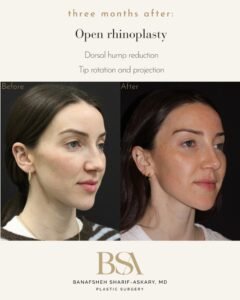
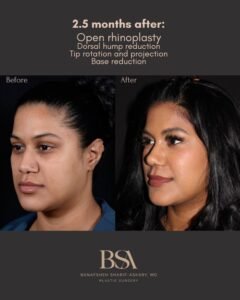
Photographs are useful for research, but I would have you look past the obvious size or shape. Note the patient’s original anatomy, symmetry, bridge and tip, and how the nose sits in relation to the face. What works on someone else is not necessarily the model for you. These images are examples, not guarantees, and we only use them with the patient’s consent. Individual results vary, and not every approach suits every candidate.
Investment and Financing
There is no one-size-fits-all price for rhinoplasty. Whether functional work is involved, the facility and anesthesia fees, and the degree of complexity will all influence the cost. A revision case presents very different considerations than a primary one, so I will discuss the cost once I have evaluated your anatomy and the plan is in place.
Given the delicate and high-stakes nature of these procedures, it is important to weigh experience and judgment over cost when you select a surgeon. After all, this is an operation where you must decide as much what to preserve as what to alter. If you’d like to put the cost of surgery on a payment plan, our Financing Options have the details. I want to make sure the financial side is clear before you decide to proceed.
Consultation
Here we move beyond the general and turn our attention to you: your particular anatomy, your concerns, and what you are looking to accomplish. A consultation is my opportunity to get a sense of how you want the outcome to look and feel, what you would like to see changed, and what you would rather leave as is.
We will review your nasal structure and facial proportions in some detail, as well as any breathing issues. With that information, we can decide if an ethnic, primary, revision, or preservation rhinoplasty is called for. I will also outline the pros and cons of open versus closed techniques and cover the risks, limitations, and recovery process so you know what to expect.
An individualized exam is necessary for these procedures since one size does not fit all. If you are thinking about rhinoplasty San Diego and desire something natural and in harmony with your features, I would be happy to see you for a consultation at BSA Plastic Surgery in La Jolla.
Schedule a Consultation
If you are considering rhinoplasty San Diego, your consultation is where we can move beyond general information and focus on you. We will discuss what you want to change, what you want to preserve, and how your nasal structure and facial proportions shape the options available to you. We can also talk through cosmetic and functional concerns, whether an open or closed approach may be appropriate, what recovery may involve, and the potential risks and limitations of surgery.
My goal is for you to leave with a clear understanding of what may be possible and a plan that is tailored to your anatomy and goals. Rhinoplasty isn't one-size-fits-all, and not every procedure suits every patient. If you want refined, natural results, I invite you to schedule a consultation at BSA Plastic Surgery in La Jolla, San Diego.
Frequently Asked Questions
Am I a good candidate for rhinoplasty?
What sets preservation rhinoplasty apart?
Do you do revision rhinoplasty?
Is it possible to improve both how I look and how I breathe?
Will the result be natural?
Medical Disclaimer
There are inherent risks with any surgery, including rhinoplasty. These can range from bleeding, infection, scarring, and prolonged swelling to asymmetry, contour irregularities, changes in smell or sensation, and persistent breathing problems. Septal issues and the need for further revision are also possibilities. Not every patient is a candidate for every procedure, so an individualized consultation is essential to establish the appropriate treatment.
BSA Plastic Surgery
- 4150 Regents Park Row, Suite 321
- La Jolla, CA 92037
- (858) 988-3771