Facelift Recovery Timeline: What to Expect, Week by Week
By Dr. Banafsheh Sharif-Askary, plastic surgeon and Assistant Professor of Plastic Surgery at UC San Diego, BSA Plastic Surgery in La Jolla, serving San Diego
"How long will I be out of commission?" is the question I hear most from patients who are close to deciding on a facelift. It's a fair one. You're planning work, family, travel and maybe an event, and you deserve a real answer.
The honest answer is a lot less dramatic than most people expect. Whether you're considering a deep plane facelift or another approach, here is what facelift recovery looks like, week by week. This is the timeline I walk my San Diego patients through at their consultations.
Facelift recovery at a glance
| When | What to expect |
|---|---|
| Day 1 | Head wrap and drain come off; you move into your compression garment (“jaw bra”) |
| Day 2 (48 hours) | Hair wash and full shower |
| Day 3 | Most patients are off narcotics |
| Days 5-7 | Driving, once off narcotics |
| End of week 1 | Sutures come out |
| Week 2 | About 80% back to normal; return to work; jaw bra’s full-time job ends |
| Week 3 | Makeup is back; scar care begins |
| Week 4 | Ready for an event |
| Weeks 5-6 | Light exercise (sometimes sooner if you’re healing well) |
| Week 6 | Back to all activities of family life, full exercise and sex |
What a deep plane facelift is, and why it matters for recovery
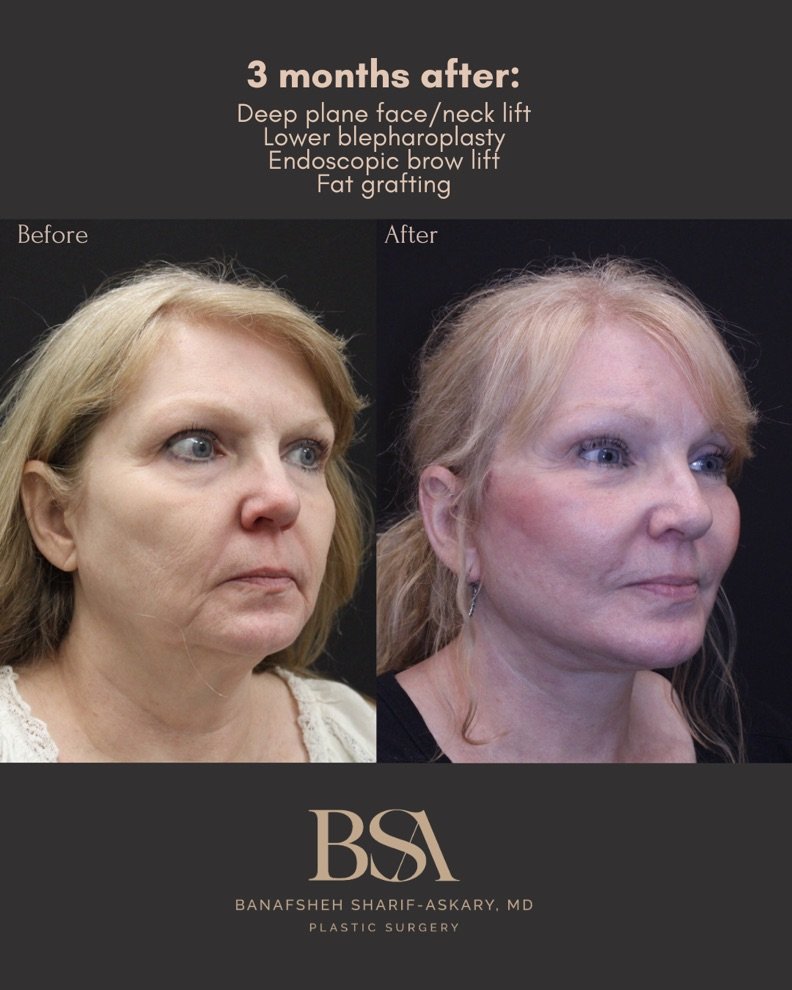
A deep plane facelift repositions the deeper tissue layers of the face along with the skin, rather than just tightening the skin. The goal is a natural, long-lasting result without the pulled look.
Here’s the part patients don’t expect: healing time with a deep plane facelift is not longer, and in some cases it’s shorter, because we’re disrupting less tissue.
I also offer many minimally invasive approaches that use smaller incisions and cause less swelling. At your consultation, we’ll talk through which approach fits your face and your goals. If you’d like to compare options first, you can read about modern facial rejuvenation options in San Diego.
Why facelift recovery is easier than most people expect
Most patients are surprised by how manageable this is. Facelifts are generally not a painful procedure, and there are a few reasons:
- Local anesthetic. We use local anesthetic during surgery, so less medicine is needed to keep you comfortable during the procedure, and you avoid the side effects of pain medications.
- A multimodal, non-narcotic approach. We layer several non-narcotic medications and techniques to manage discomfort holistically. Most patients are off narcotics by day 3.
- Early movement. You won’t spend your recovery in bed. More on that below.
Week 1: Out of commission, but not bedridden
The days of lying flat in bed for a week after surgery are over. We now know that’s not good for you, and I want you up and moving.
What I want you doing:
- Getting up and making yourself something to eat. Heat up soup, make a sandwich. (Not a five-course meal. Let’s not get ambitious.)
- Walking around the house and using the bathroom on your own
- Taking short walks outside, with sun protection
What I don’t want you doing:
- Vacuuming
- Heavy housework or chores
- Sex
- Anything else that gets your heart rate and blood pressure up
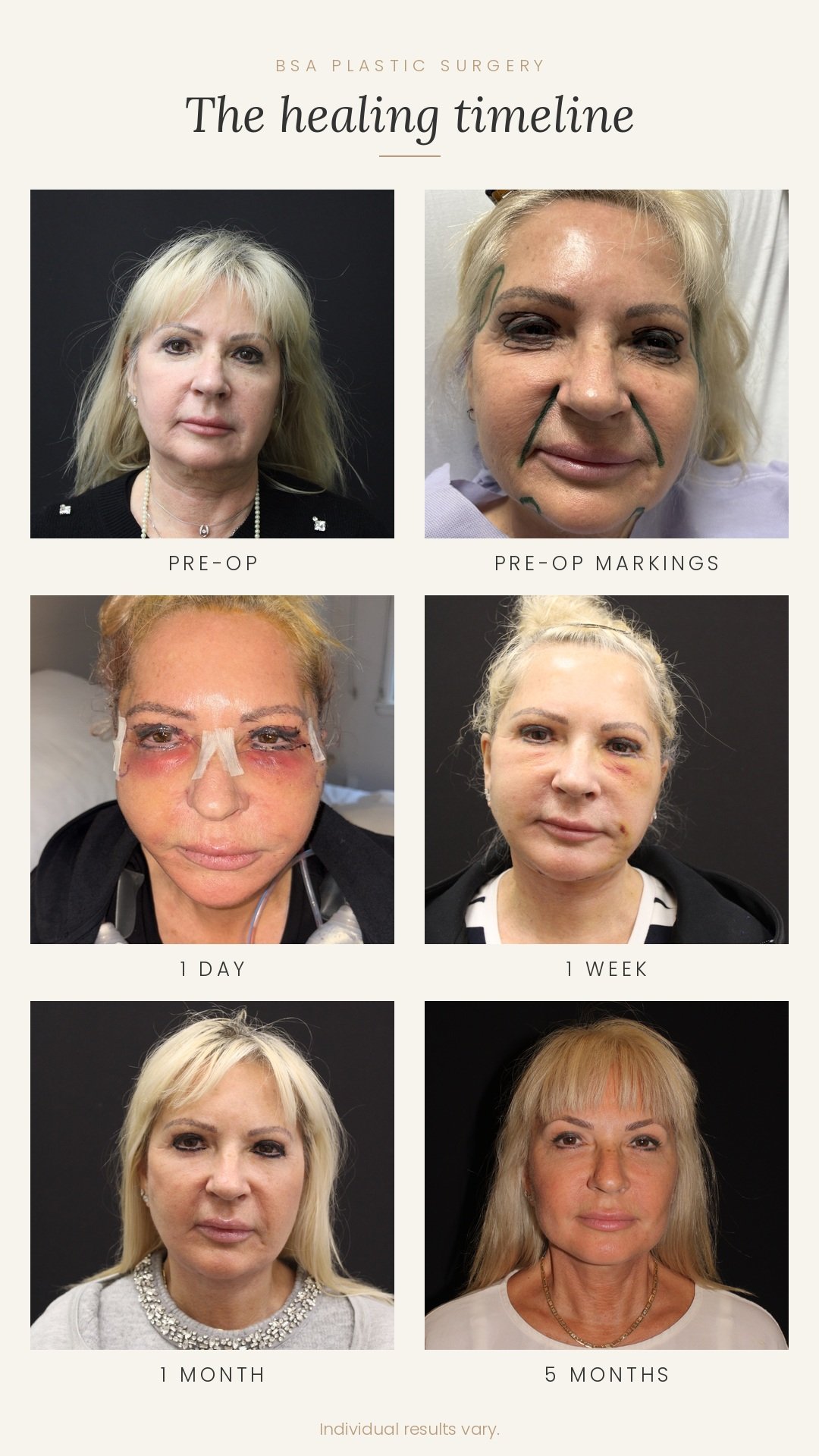
What to expect: The big head wrap comes off the day after your facelift. That’s also when your drain comes out. You’ll then move into your compression garment and start applying ointment to your incisions every day. You can wash your hair and take a full shower 48 hours after surgery. Your sutures come out at the end of the first week.
Someone with you: Plan to have someone stay with you for at least the first 48 hours. They can help with meals, medications, and rides to your follow-up visits.
Staying in San Diego: If you’re traveling from out of town, plan to stay in San Diego for at least one week after surgery, so we can see you for your early follow-up visits.
Meet your new accessory: the “jaw bra”
Your compression garment is sometimes called a jaw bra, and it’s one of the most important parts of your recovery. It helps your skin settle into the contour we created in surgery, and it reduces swelling.
The rule is simple: wear it 24/7 for two weeks. You can take it off for a short stretch, like a dinner out, but otherwise it stays on. It isn’t glamorous, but it works.
How to sleep after a facelift
Sleep on your back. Lying on your face or side will worsen swelling and can hurt your incisions, so plan on back sleeping for at least 3 to 4 weeks. A pillow on either side of you can help keep you from rolling over in your sleep.
Week 2: Looking more like yourself
By the end of week two, my patients tell me they feel about 80% back to normal. You’ll still have some residual swelling and some bruising, but you’ll look much more like yourself. Around this point, your jaw bra’s full-time job is done, and most patients return to work.
One happy patient put it this way:
“I was back to Zoom calls after one week and seeing my therapy patients in the office at two weeks.”
(Shared with the patient’s consent. Individual results vary.)
One caveat: If you add laser resurfacing or facial fat grafting to your facelift, plan for more time. Laser resurfacing treats the skin itself, so you may look worse before you look better. Fat grafting injects fat to smooth lines and improve skin quality, and it often brings extra swelling. With these add-ons, healing can stretch to about three weeks. The results are worth it, but it’s better to plan for the longer timeline than to be surprised by it.
Week 3: Makeup is back
If everything has healed well, you can start wearing makeup again. This is also when scar care begins. We use silicone gel and medical-grade skin care to help your incisions heal as well as they can. We’ll show you exactly how and when to use them, and adjust the routine as your incisions mature.
Week 4: Ready for an event
By the end of the first month, you should be ready for a big event, whether that’s a wedding, a reunion or a milestone birthday. Any swelling that’s left will be noticeable only to you and me.
Numbness: what to expect and what we do about it
Numbness can last several months. We give you a protocol to help improve it, which includes massage and topical treatments, and most patients don’t notice it.
Weeks 5 to 6: Back to everything
Around weeks five to six, you can start light exercise, and sometimes sooner if you’re healing well. By week six, you’re back to all the activities of family life, full exercise and sex. One thing to know: the more active you are, the more your face may swell. Listen to your body, ease back in, and don’t let a first-day-back burst of enthusiasm undo your progress.
I never want to hold my patients back. We work with you to design a regimen that’s safe and fits your goals.
For the rest of your life: sun protection (yes, even in San Diego)
I’d be doing you a disservice if I didn’t say this. We live in one of the sunniest places in the country, and La Jolla beaches, Coronado afternoons and 70-degree days in January are all very hard to resist. Wear sunscreen, hats, sunglasses, and all of it, forever.
You just invested in a fresh face. Don’t hand the sun your deposit. Think of sunscreen as a cheap insurance policy on a very expensive result. Your future self, who is still glowing at the reunion, will thank you.
Is a facelift painful?
Generally, no. We use local anesthetic during surgery, so less medicine is needed to keep you comfortable and you avoid the side effects of pain medications. We also use a lot of multimodal, non-narcotic medication to manage discomfort holistically. Most patients are off narcotics by day 3.
Is deep plane facelift recovery longer than a traditional facelift?
No. Healing time with a deep plane facelift is not longer, and in some cases it’s shorter, because we’re disrupting less tissue.
Do you offer minimally invasive facelifts?
Yes. I offer many minimally invasive approaches that use smaller incisions and cause less swelling. We’ll talk through which approach is right for you at your consultation.
When can I drive after a facelift?
Once you’re off narcotics, which is generally by day 3, you can start thinking about driving. Most patients are driving between days 5 and 7.
When can I go back to work?
Most patients return to work at about two weeks. If your job is client-facing, you may want to give yourself a bit longer.
When can I return to all my normal activities?
At about six weeks, you’re back to all the activities of family life, full exercise and sex. Light exercise can usually begin at about five to six weeks, and sometimes sooner if you’re healing well. We’ll design a regimen with you that’s safe and fits your goals.
How long do I need to wear the compression garment (jaw bra)?
Plan on wearing it 24/7 for two weeks, with short breaks like a dinner out.
When do the stitches come out?
At the end of the first week.
Will I have a drain?
Yes. It comes out the day after surgery, along with the head wrap.
When can I wear makeup?
Around week three, if everything has healed well.
How should I sleep after a facelift?
On your back. Lying on your face or side will worsen swelling and can hurt your incisions, so plan on back sleeping for at least 3 to 4 weeks.
When can I wash my hair and shower?
You can wash your hair and take a full shower 48 hours after surgery.
How long will my face be numb?
Numbness can last several months. Our numbness protocol includes massage and topical treatments, and most patients don’t notice it.
How long should I stay in San Diego before flying home?
At least one week after surgery, so we can see you for your early follow-up visits.
Will I need someone to stay with me?
Yes. Plan to have someone stay with you for at least the first 48 hours.
When will I be ready for a big event?
By the end of the first month, you should be ready. Any swelling that remains will be noticeable only to you and me.
The nice thing: we're with you every step of the way
Recovery can feel like a lot, but you won't be doing it alone. At BSA Plastic Surgery, we're here for you every step of the way, from your first consultation through your final check-up and beyond. Every patient heals a little differently, so we'll adjust the plan for you.
Thinking about a facelift in San Diego? Schedule a consultation with Dr. Banafsheh Sharif-Askary in La Jolla, and we'll talk through what recovery would look like for you. Call (858) 988-3771 or visit bsaplasticsurgery.com.
Facelift surgery, including deep plane facelift, carries potential risks and complications. The timeline above is a general guide, and individual recovery varies. An individualized consultation with a qualified plastic surgeon is necessary to determine appropriate treatment options and discuss risks, benefits, alternatives, and expected outcomes.
Request Your Consultation